
Probation is not the same as a 90 day trial period. A probation clause does not remove personal grievance rights. The employer still needs a fair process and a fair and reasonable reason for dismissal.
Common probation mistakes
- No warnings: the employer stays silent, then ends employment with a surprise dismissal.
- No support: no training, no clear expectations, and no chance to improve.
- Predetermination: the decision is effectively made before the employee can respond.
- Confusing probation with a trial: the employer assumes rights are limited when they are not.
Probationary Period Dismissal
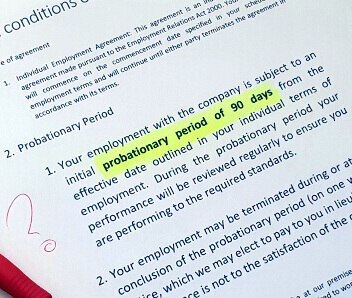
An employer cannot simply terminate an employees employment on reliance of a probationary period without being able to justify termination both substantively and procedurally.
Section 67 of the Employment Relations Act 2000 permits parties to an employment relationship to agree that the employee will serve a period of probation at commencement of employment.
An employer when dismissing an employee in reliance of a probationary period still must comply with the duty of good faith and must be able to justify the dismissal that it is substantively and procedurally fair.
If an employer withholds any concerns during a probationary period as to the employee's shortcomings, the employee would have reasonably developed an expectation of continued employment. Therefore, a surprise dismissal at the end of a probationary period without prior warning from the employer will easily result in dismissal being unjustified.
Probationary Period Law
- Where the parties to an employment agreement agree as part of the agreement that an employee will serve a period of probation after the commencement of the employment,- Subsection (1) does not-
- the fact of the probation period must be specified in writing in the employment agreement; and
- neither the fact that the probation period is specified, nor what is specified in respect of it, affects the application of the law relating to unjustifiable dismissal to a situation where the employee is dismissed in reliance on that agreement during or at the end of the probation period.
- Failure to comply with subsection (1)(a) does not affect the validity of the employment agreement between the parties.
- However, if the employer does not comply with subsection (1)(a), the employer may not rely on any term agreed under subsection (1) that the employee serve a period of probation if the employee elects, at any time, to treat that term as ineffective.
The Court of Appeal said:
"Every probationer may be taken to realise that being on trial he or she will be under close and critical assessment and that permanent employment will be assured only if the employer's standards are met. The employer for its part may not be simply a critical observer, but must be ready to point out shortcomings to advise about any necessary improvement and to warn of the likely consequences if its expectations are not met. Because the objective is always that the trial will be a success, not a failure, both parties must contribute to its attainment. If it becomes apparent to the employer, judging fairly and reasonably, that the trial is not a success, the employee is entitled to fair warning before the end of the probationary period that the employment will then be coming to an end."
Employee rights during a Probationary Period
Because the purpose of the probationary period is to assess an employee's suitability for a job, an employer should allow an employee to:
- be allowed to work out the full probationary period.
- receive proper training.
- be made aware of any shortcomings or problems during the probationary period.
- be given every opportunity to demonstrate to the employer that he or she will be suitable.
Read our full article
We write for the Deals on Wheels magazine. Read our full article:
Dismissed during probation?
You still have personal grievance rights and process matters. Submit the case form with your timeline, any warnings, and any letters or emails about performance concerns.
Employee Case Form