Mr Anderson's Bad Language
Passion, procedure and theatre in the employment jurisdiction.
Don't you mean Mr Bligh's Bad Language?
The title borrows from Greg Dening's Mr Bligh's Bad Language: Passion, Power and Theatre on the Bounty. Dening did not treat Bligh's language as a collection of offensive words detached from their setting. He examined authority, performance, conflict and the mythology later built around them.
Employment litigation is not the mutiny on the Bounty, but the comparison is useful. A memorable insult can become the whole public story while the procedural mistake, evidential dispute or legal issue that caused the conflict disappears from view.
At a glance
- The Employment Court has criticised some of my communications as unprofessional and, at times, "abusive".
- David Fleming told The Post that I called him “Fuck Face”. I used the expression in response to his threatening contempt proceedings after demanding documents that Mr Joyce and I repeatedly said did not exist.
- Neither Mr Joyce nor I was found in contempt of Court.
- In Menzies v Corrigan, I brought it on Mr Menzies' instructions and there were proper reasons for doing so.
- Calling Daniel Church a “moron” attracted media attention. The Registrar nevertheless confirmed my procedural point: a separate claim was required to seek compliance relief, including imprisonment, against Mr Menzies.
- The wider point is simple: poor language should be criticised, but it does not answer the underlying law or procedure.
The published record
| Source | Language or allegation | What the source actually establishes |
|---|---|---|
| David Fleming's statement to The Post concerning the Joyce litigation | Mr Fleming reported that I had called him “Fuck Face”. | The expression was supplied to the media by Mr Fleming rather than reproduced in the Employment Court judgment. My account is that I did so while he was threatening contempt proceedings and demanding documents that Mr Joyce and I repeatedly said did not exist. |
| Joyce v Ultimate Siteworks Ltd [2024] NZEmpC 204 | The judgment records allegations of abusive emails, late-night calls and texts, including contact at 1.21 am, and one-star Google reviews. | It was made out to be a lot worse than it actually was. |
| Annexure C — 24 October 2024 email; later evidence in Menzies v Corrigan | “Most lawyers I come up against are lacking the R in IRAC for relevant law, and the A for application of said relevant law.” | These are my words in an email marked “without prejudice”. I maintain that the email was privileged. It was later relied on as an example of disparaging communication. My underlying criticism was that much employment-law advocacy fails to identify the relevant law and apply it properly to the facts. |
| Annexure C; Menzies v Corrigan [2025] NZEmpC 186 at [83] | “Lawyers that work in the employment jurisdiction in my opinion are incapable of dealing with matters that require the use of the human brain.” | These were also my words in the same email. I later described the remark as humour or jest. |
| Annexure F — 3 December 2024 email; related references in Menzies v Corrigan [2025] NZEmpC 186 at [70(a)] and [94] | “The Employment Court Regulations are being contravened by a moron. See below the regulations. A Claim must be filed for this.” | The procedural point was that fresh compliance relief required a separate claim. That included the attempt by Catherine Stewart Barrister's office to seek imprisonment against Mr Menzies. The Registrar confirmed that a separate statement of claim was required. |
| Menzies v Corrigan [2025] NZEmpC 186 at [70] | “stupidity”, “bullshit”, “pull finger out their asses”, “dumbarses”, “dropkicked him”, and “those idiots”. | The judgment reproduced parts of a private email I sent to a third party, Simon Schofield, editor of the New Zealand Employment Law Guide. |
| Menzies v Corrigan [2025] NZEmpC 186 at [82] | An allegation that I called Daniel Church a “clown”. | The judgment records my denial and my explanation that the “clown” remark concerned a former client, not Mr Church. |
David Fleming and “Fuck Face”
David Fleming told The Post that I had called him “Fuck Face”.
The words did not appear in an Employment Court judgment. They entered the public record when Mr Fleming supplied them to The Post for the first mainstream article about my conduct in Joyce v Ultimate Siteworks Ltd.
I used the expression because Mr Fleming was threatening contempt proceedings while demanding documents that Mr Joyce and I repeatedly said did not exist. The dispute concerned disclosure, including alleged job-application documents. Our position was straightforward: the documents did not exist and could not be disclosed. Repeatedly threatening contempt while demanding non-existent documents was unprofessional and abusive, hence the reciprocal insult was used in this case.
The published judgment made no finding that either Mr Joyce or I was in contempt. It also did not reproduce the expression later given to the media.
The incident illustrates the Bligh comparison. The nickname reduced a complicated dispute about disclosure and threatened contempt to a memorable story about an advocate insulting a barrister who would not accept my advice that documents sought never existed. It may also sound like something from Mrs Brown's Boys.
The “human brain” email
“I read a lot… Most lawyers I come up against are lacking the R in IRAC for relevant law, and the A for application of said relevant law. Lawyers that work in the employment jurisdiction in my opinion are incapable of dealing with matters that require the use of the human brain.”
The statement appeared in an email marked “without prejudice”, which I maintain was privileged.
IRAC means identifying the issue, finding the relevant law, applying that law to the facts, and reaching a conclusion. My criticism is that many employment-law submissions state conclusions or repeat facts without properly identifying and applying the governing law. Some are so poor that it is difficult to understand how some employment lawyers even got a law degree.
I remain sharply critical of much of the work, but the criticism is stronger when directed at the actual submission rather than the intelligence of the person who wrote it.
The source email is published here: Annexure C - the “human brain” email.
The “moron” email
“The Employment Court Regulations are being contravened by a moron. See below the regulations. A Claim must be filed for this.”
This was directed at Daniel Church. I regret the insult, which later received considerable media and LinkedIn attention.
The underlying dispute concerned an attempt to seek fresh compliance relief, including imprisonment, within an existing de novo challenge. My position was that the challenge did not provide a procedural vehicle for that relief and that a separate Form 2 statement of claim was required. Nobody appeared willing to acknowledge my reference to the required practice and procedure at the time.
The Registrar later confirmed the essential position: the Authority's compliance determination stood on its own, a separate statement of claim was required, and the relief was not available within the existing challenge. So I was right.
The source documents are:
The “bullshit”, “dumbarses” and “idiots” email
The most concentrated published collection appears in Menzies v Corrigan [2025] NZEmpC 186 at [70]. The Court reproduced portions of a private email I sent to a third party on 26 February 2025.
“Thank you for recognising the stupidity of the Authority Member… It is bullshit.”
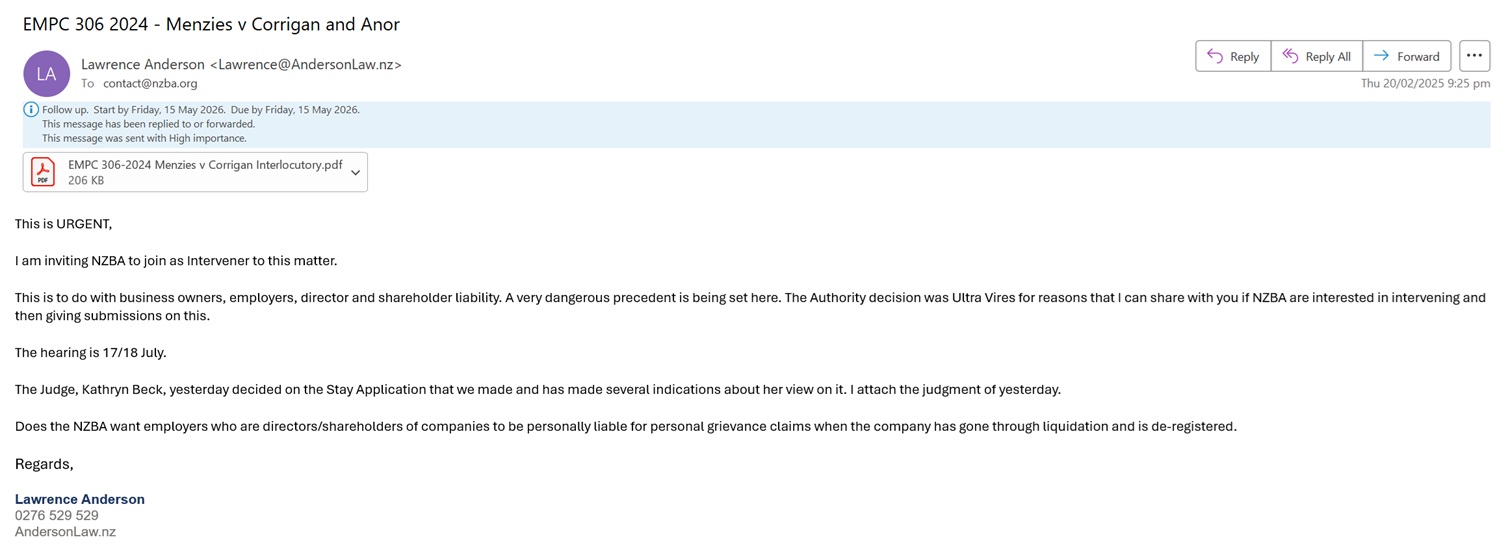
“EMA and NZBA I have asked if they want to pull finger out their asses and to intervene.”
“The LinkedIn community and most of the names of people that like and comment, they are all dumbarses…”
“Catherine Stewart Lawyers took advantage of Nathan Corrigan, they exploited him, and have now dropkicked him.”
“Please don't subscribe to those idiots.”
The email was not a judicial submission. It was private correspondence with Simon Schofield, editor of the New Zealand Employment Law Guide. I remain surprised that it became part of the Court's discussion.
“NZBA” meant the New Zealand Business Association, not the New Zealand Bar Association. Some reporting got that wrong. The error materially changed the identity of the organisation and could easily have been avoided by asking me.
Joyce: the judgment did not publish every word
The public record in Joyce v Ultimate Siteworks Ltd is broad but not especially specific. The judgment records allegations of abusive communications, late-night calls and texts, and online reviews, including a text sent at 1.21 am on the day the substantive hearing was due to begin.
I accepted responsibility for most of the communications, apologised and offered an undertaking to communicate with ordinary professional courtesy. There was no contempt finding against me.
Mr Fleming sought increased costs because of my conduct, but the Court recorded that the conduct did not appear to have increased the costs of the proceeding. The requested increase was not awarded.
Read the judgment: Joyce v Ultimate Siteworks Ltd [2024] NZEmpC 204.
What the Employment Court found in Menzies—and why I disagree
In Menzies v Corrigan [2025] NZEmpC 186, Judge Beck held that the non-party discovery application against Catherine Stewart Barrister was “fatally ill-founded”. The Court considered that other sources should have been pursued, including the Authority and the liquidator, and that the application raised obvious issues of relevance and legal privilege.
The Court found that a proper and dispassionate representative would not have pursued the application in that manner. It described my conduct as “most improper” and “entirely unacceptable”.
I completely disagree with that, and I explain why here below.
Why the application was brought
The application did not arise from a random personal dispute with Ms Stewart. It arose from the way important financial documents had entered the case against Mr Menzies.
The Authority had directed the liquidator to produce financial statements, bank information and material supporting the allegation of “excessive drawings”. Documents responsive to that direction were then received and forwarded through Catherine Stewart Barrister's office rather than being produced directly by the liquidator.
Those documents were used to support serious allegations that Mr Menzies had siphoned company funds, conducted a sham liquidation and moved into phoenix-style business activity to avoid liability. Their provenance, completeness and reliability therefore mattered.
The unresolved questions included what the liquidator had actually supplied, whether everything ordered by the Authority had been produced, whether there were additional documents or covering communications, and whether the parties and the Authority had received the complete document trail.
Mr Menzies instructed me to seek discovery of that material. At the time, the company had been deregistered, the former liquidator no longer held office, and a notice requiring disclosure sent to Mr Corrigan and his then representatives had not produced the requested documents. The contemporaneous communications indicated that relevant material was likely to be held by Catherine Stewart Barrister's office.
Why I reject the description “improper”
I do not accept that this made my conduct personally improper or showed that I had taken over the case for my own purposes.
The Court accepted that there was no evidence that I had acted without Mr Menzies' instructions. I was attempting, on those instructions, to establish the provenance and completeness of evidence being used to make serious allegations against him personally.
The application may fairly be described as unsuccessful, procedurally ambitious or directed at a source the Court considered inappropriate. That is different from saying it was brought in bad faith, for harassment, or because of some personal campaign against Ms Stewart.
The document-pathway problem was real. Documents ordered from an independent liquidator had passed through the office acting against Mr Menzies and were then relied on as evidence against him. Seeking to understand that pathway was a legitimate evidential objective, even though the Court rejected the mechanism used to pursue it.
The Court ordered me personally to pay:
- $1,417.75 for the non-party discovery application;
- $313.93 on my own costs application; and
- $800 on Ms Stewart's costs application.
The total was $2,531.68, which I paid within 24 hours. I also remain critical of the time said to have been incurred responding to the application. Ms Stewart's calculation referred to almost six days of work at $500 per day, while the substantive opposition consisted of a one-page notice and a one-page unsworn affidavit.
The Court did not reject the application for non-party discovery, it was withdrawn by me on instructions from Mr Menzies before the merits of it was decided. That being at the same time that Mr Menzies was required by the court to pay over $30,000 into the court registrar account if he wanted to continue his challenge as a condition on the stay application. He could not carry on under those conditions.
I maintain that it was brought in good faith, on my client's instructions, to investigate the completeness and pathway of evidence being used against Mr Menzies.
The underlying disclosure history is examined here: Menzies v Corrigan and the liquidator disclosure problem .
Bad language can conceal bad procedure
The point of this article is not to celebrate abuse. It is to resist the easy story in which one representative swears, the Court criticises him, and every underlying legal issue is treated as resolved.
Real litigation is less tidy. A failed application may still expose a document-pathway problem. An improperly expressed objection may still identify the correct pleading. A successful party may still have spent an irrational amount of money. A courteous lawyer can be procedurally wrong; an abusive advocate can be right about a particular point.
My conclusion
I called Daniel Church a “moron” because I considered his procedural position plainly wrong. I called David Fleming “Fuck Face” after he threatened contempt while demanding documents that Mr Joyce and I repeatedly said did not exist. Mr Fleming should have acted with more courtesy and professionalism to me on that point. I said employment lawyers were incapable of using the human brain because I was frustrated by what I regarded as consistently poor legal work, which I am of the view that their work was crap.
I also described an Authority decision as “bullshit”, referred to people as “dumbarses” and “idiots”, told business organisations to pull their fingers out, and said Catherine Stewart Barrister took advantage of Nathan Corrigan, exploited him and then dropkicked him. I did not refer to the New Zealand Bar Association; “NZBA” meant the New Zealand Business Association.
My criticism should be tested against the documents, the procedure and the law — not accepted or rejected merely because of the way I expressed it.
Now piss off and go and do some real work you bastards.
Primary documents and related commentary
- Greg Dening, Mr Bligh's Bad Language: Passion, Power and Theatre on the Bounty
- Joyce v Ultimate Siteworks Ltd [2024] NZEmpC 204
- Menzies v Corrigan [2025] NZEmpC 186
- Catherine Stewart Barrister - Daniel Church LinkedIn emails (context)
- Joyce v Ultimate Siteworks - advocate and lawyer conduct
- Menzies v Corrigan - employment advocate and lawyer conduct
- The public record on Joyce, Menzies, LawNews and RNZ
- LawNews reporting on the Menzies costs judgment
- Menzies v Corrigan and the liquidator disclosure problem


![Menzies v Corrigan [2026] NZEmpC 151 - a procedural loss that still avoids the real issues](/Blog/articles/Employment_Law_News_Opinion/menzies-v-corrigan-2026-court-151/4eddf0_9083d25fdcfa42f192e1d1c26ebdb0a8~mv2.jpg)