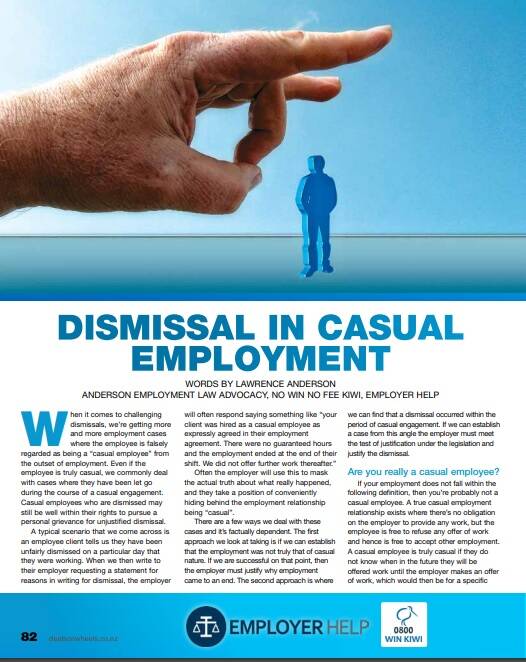
Casual dismissal still needs justification
In New Zealand, casual employees have employment rights. A casual engagement does not give an employer a free pass to end things unfairly. If you are dismissed during a period of work, the employer still carries the onus of justifying what they did.
The Employment Relations Authority and Employment Court have the power to determine the real nature of an employment relationship. That means the label "casual" is not decisive. If the reality is ongoing, regular work with an expectation it will continue, the relationship may be treated as permanent.
Casual or permanent - how it is assessed
Determining whether employment is casual or permanent can be assessed from a number of factors, including:
- Regularity and pattern of work hours (weeks or months of regular shifts can indicate permanence).
- Rosters (being rostered on in advance looks less "casual").
- Notice and control (do you have to find cover, seek approval for leave, or give notice of absence).
- Mutual expectation that work will continue (even if no guarantee is stated).
- How you were treated (training, uniforms, company systems, performance management, warnings).
A common mistake is for employers to assume that because work is described as "casual", there is no need for process. In reality, even in genuinely casual work, dismissal during a period of engagement can still be challenged.
What to do if you were dismissed from casual work
- Act quickly: a Personal Grievance (PG) generally must be raised within 90 days.
- Write a timeline: key dates, who said what, and what happened immediately before dismissal.
- Save evidence: rosters, texts, emails, app messages, timesheets, photos, and anything showing regular work.
- Request reasons: if you were not given clear written reasons, ask for them in writing.
What we typically check
- Was there a genuine casual arrangement, or was it effectively ongoing employment.
- Was there a fair process (notice, information, time to respond, open mind).
- Was dismissal a proportionate outcome, or were alternatives reasonable.
- Any "trial period" or "probation" issues if the employer relied on them.
The fastest way is to submit the case form with a short timeline and key documents.
Employee Case Form
Common scenarios we see
- Shifts suddenly stopped after you raised a concern, asked for pay, or queried rosters.
- Told "you are casual" as the reason for ending work, without any process or explanation.
- Regular weekly hours for months, then an abrupt termination when conflict arises.
- Dismissal by text (or being removed from the roster) without a meeting or chance to respond.
If this looks like your situation, it may be an unjustified dismissal or disadvantage claim, even if the employer calls you casual.
For employers - how to reduce risk
- Be clear in writing about when work is offered and that each engagement is separate.
- Avoid creating an expectation of ongoing work if the intention is truly casual.
- If you end an engagement mid-stream, treat it like a dismissal and follow a fair process.
- Keep good records of rosters, offers of work, acceptance, and communications.
What remedies may be available
If a Personal Grievance (PG) for unjustified dismissal is successful, remedies can include:
- Lost wages and related entitlements.
- Compensation for hurt and humiliation, depending on the facts.
- Reinstatement in appropriate cases (less common for genuinely casual work, but possible where the real relationship was ongoing).
Read our full article
We write for the Deals on Wheels magazine. Read the full article here: